Showing posts with label Birdfeeders. Show all posts

Sunday, 19 April 2015

Birds For Windows


It's been a busy few days so apologies for not being able to do a more substantive post.

The window feeder has continued to provide some excellent views of the blue tits who are regular visitors to the feeder and quite tolerant of us being behind the glass as long as we don't make any sudden movements.

The blackbirds had taken to using it, but they had a habit of sweeping all of the food out of the feeder leaving nothing for the other birds.  We remedied this by moving the separate perspex roof of the feeder lower so they couldn't land (there is plenty other food that we provide that they can access).

We were pleasantly surprised when one of the skittish coal tits plucked up enough courage and started to be a regular visitor to the feeder.  Unlike the blue tit, he was gone as soon as he saw any movement at all.  I managed to get these shots because I had staked out the feeder.  There where far more bad ones than good.


Sunday, 22 February 2015

Over the Border

 Living in the north of Nottinghamshire, geographically we sit on the edge of neighbouring counties.  Ten minutes drive and we're in South Yorkshire or Lincolnshire.  Lincoln is actually the closest city to us.

Our retired neighbour, Bill pointed us in the direction of Whisby Nature Reserve in Lincolnshire, so a few weeks ago we decided to hop over the border and pay a visit.

We were surprised by how large the reserve was, with several large lakes on the site.  A large part of the reserve was closed when we visited, as a bridge that was being built over a train line was not quite finished.  It is hoped that it will be open at the end of February.


There are numerous hides where you can watch what is going on out on the water and a rather impressive centre which includes a shop and large cafe.  I also took a few photos of the bird feeders that they had set up from a nearby viewing point.  I thought that our own garden feeders had a lot of Grey and Blue Tits using it.  At Whisby there seemed to be dozens of them.


We're looking forward to exploring more of this reserve in the coming weeks.  When we visited it was cold, dull and very overcast and I'm looking forward to seeing what else this great reserve has to offer.

Sunday, 18 January 2015

Garden Gremlins


We've always had one or two squirrels that make themselves at home in the garden.  They can be quite entertaining chasing each other around the garden and through the trees.  For all of their cheeky charm they can be a nuisance.  They can wade through a bird feeder full of sunflower hearts in less than a morning.
You scratch my back...

I may not be the grey squirrel's biggest fan, but nor would I do anything that would injure or hurt them in anyway so we've opted for more preventative measures to stop them stealing the food by adding chilli powder.  They can still help themselves to the peanuts we put out, the feeders themselves tend to restrict them from guzzling the lot.


They can be a bit brazen when it comes to feeding.  The picture below is just before he makes a leap for the window feeder.  He almost seems to be checking if the coast is clear.

Casing the joint


The inevitable outcome was squirrel and window feeder taking a tumble.

It's fun to watch them speeding through the treetops and the incredible distance they achieve when leaping from one tree to another.  Their agility is second to none.


As of last Sunday, we currently have four squirrels in the garden.  We watched them chasing one another but we aren't sure if they are a family unit or two pairs that are defending their territory.  Some of them also seemed to have developed a taste for chilli as we've spotted greys munching at the coated sunflower hearts with enthusiasm.

We're going to need to come up with a plan B.


Sunday, 4 January 2015

All and Sundry

The last sunrise of 2014


In the past few weeks, we have replaced damaged bird feeders and have just started to experiment with different food stuffs.   Over the past few months the type of birds that we've had at the feeders have been pretty consistent, sparrows, robins, great tits and blue tits.

The blue tits in particular have finally discovered the window feeder that we've affixed to the kitchen window. I bought the feeder on a whim but it took weeks before the birds seemed to take any interest in it.


When the snow and cold weather arrived on Boxing Day, temperatures in the area barely climbed above zero during the day and the nights where subzero for the next week.  Subsequently, the feeders have been busier than usual.

Long Tailed Tits band together during the winter to share heat during the night.  They also tend to stay close to each other during the day so it's not uncommon to see over a dozen of them on the fatballs and the peanut feeder.


With so many birds around, there has been plenty of squabbling.  Robins, starlings and blackbirds are constantly skirmishing with each other but one of the strangest confrontations we have seen  was a squaring off between the normally mild mannered woodpigeon and  a jackdaw.  The jackdaw is very partial to the bread that we throw out and most birds keep out of its way.  The woodpigeon was having none of this and chased the jackdaw away from the bread.  Bizarrely, the woodpigeon doesn't eat bread.


Woodpigeon vs Jackdaw


We've also spotted more greenfinches and coal tits around than normal.  Coal tits are small timid birds that fly onto the perch of the feeders, grab some food and fly off in a matter of seconds.  We have counted five greenfinches on one feeder at the same time with one of the birds actually feeding the others which makes us think that they are part of a family unit.


The elusive coal tit and a greenfinch


The Greater Spotted Woodpecker has also been a more frequent visitor to the nut feeder.  It won't tolerate any other birds on the feeder and will quickly chase off any that dare land on it.


At the moment, we've been refilling the bird feeders three times a week.  With so many birds around it was only a matter of time before the predators paid a visit.  We`ve seen plenty of  opportunistic  fly-bys  from sparrowhawks and kestrels hoping to catch a inattentive bird while feeding.  They've had some success judging from the circles of feathers we keep feeding in the garden.

One bird that I am hoping will return is the pale pink female bullfinch that we saw on the hedge checking out the feeders.  It was the first time that I had seen a female bullfinch before and would love to be able to get some good pictures of her.


Sunday, 2 November 2014

Trial and Error


There are times when I think we have the most spoilt garden birds in the county.  Currently, we have nine different bird feeders in two locations around the garden in addition to two bird baths and a drinking spot.  The first feeding area is directly outside the kitchen window where the feeders hang from the branches of a silver birch tree. The second is a free standing feeder station that we located in the corner of the garden.
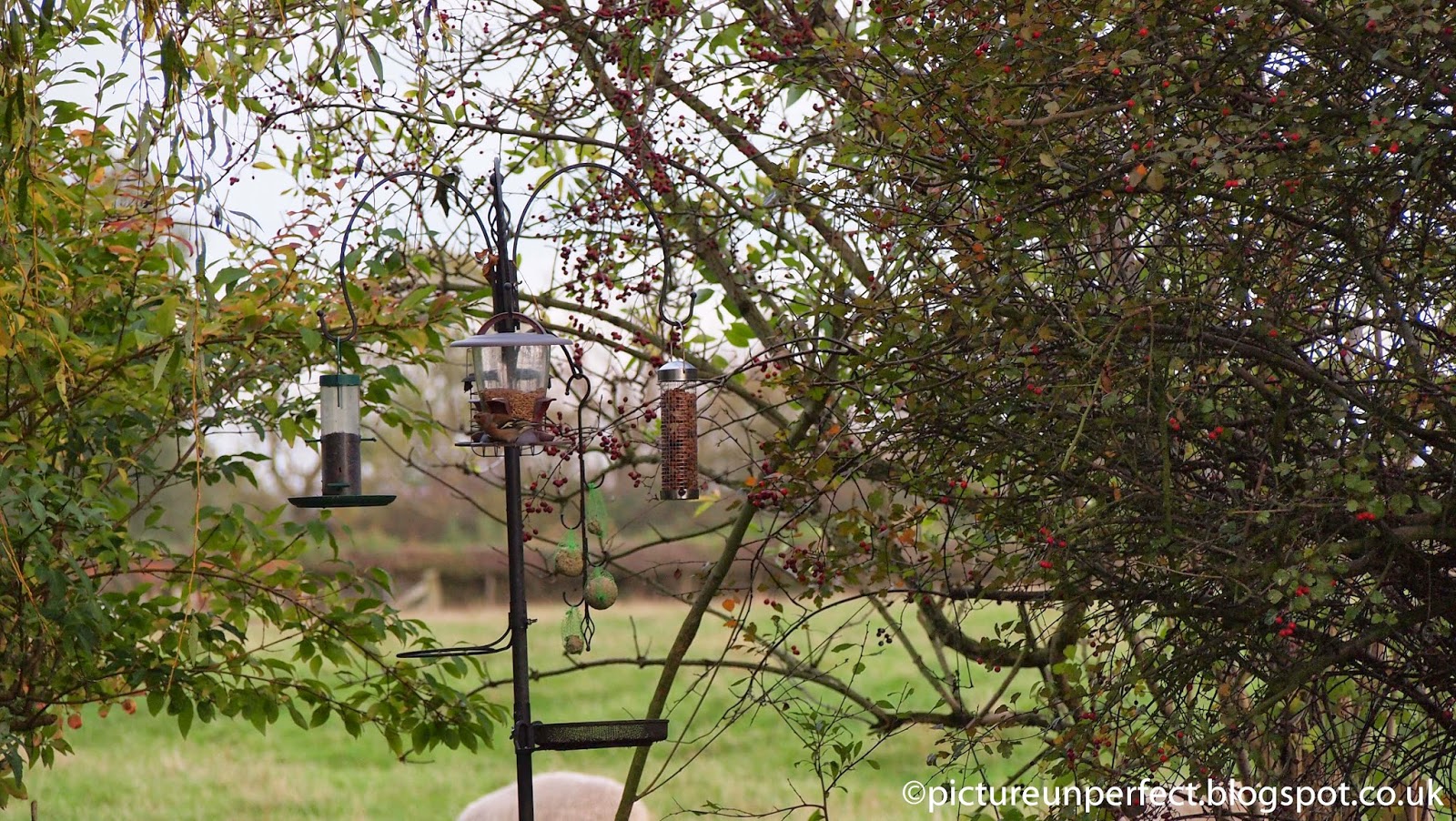
The feeding station in the corner of the garden.


There's been a fair bit of trial and error over the years but what we found works best for us in our particular garden can be completely different a few gardens away (our neighbour Bill regularly gets different bird visitors than ourselves despite being just over a hundred metres from us).  Here are a few tips that we've learnt over the years that might be helpful.

Reduce the Waste
We use peanuts, fat-balls, niger seed and by far the most popular are sunflower hearts.  Sunflower hearts are a little more expensive that sunflower seed but it does cut down on the messy seed husks the birds discard.  We were shocked to see a large brown rat one morning chomping away on the discarded husks, not what you want to see close to a kitchen door. Sunflower hearts definitely reduce the mess.

Niger seed, is very popular with goldfinches, but it will also kill the grass underneath the feeder after a while.  We use a niger feeder with an detachable tray, this cuts down on the amount of seed that hits the ground.

Location, Location, Location
Birds seem to prefer a bit of cover close to the feeders, so they can dash to safety should a Sparrowhawk or other predator put in an appearance.  We originally placed the feeding station in an open area of the garden and nothing used it.

A Bullfinch pays a visit


Feeders
The choice of available bird feeders now is staggering.  We've worked our way through quite a few and personally (for our circumstances anyway) more expensive metal feeders for the sunflower hearts and peanuts work best.  Remember that you need to clean and sterilise the feeders regularly to avoid any nasty diseases that can spread through the bird population and metal feeders tend to be more resilient to repeated disassembly and reassembly.

If you can provide a source of water for the birds as well, this would be fantastic.  You'll be surprised just how many birds this can attract to your garden.

A place to bathe is always welcomed


Squirrels
I'm not the greatest fan or grey squirrels and if you have them in your garden chances are they will pretty much trough what food you have out,  They can also destroy your feeders themselves by biting through the perch plugs and pulling them out, thus emptying the food all over the ground.  Metal feeders can stop the destruction but they can still get the food. (although they don't bother with niger seed so we just have a plastic feeder for this).  If you mix in chilli powder with the feed the squirrels won't go near it and it won't have any effect on the birds.  (I'm not totally heartless, I don't do this with the peanuts so they can eat something untainted).

The plastic birdfeeder was ruined within the week.


You can't stop
If you start putting food out for birds, especially in the winter months when food is scarce, then you need to understand that it is a long term commitment.  Birds will come to depend on this source of sustenance, and if you forget to refill the feeders or just plain stop then you could unwittingly have a detrimental impact on the bird population.

It is worth it, because you get to see things like this.

A Greater Spotted Woodpecker loves fat-balls.