Saturday, 8 November 2014

Bringing up Baby - Saving a Woodpigeon Chick (Part 1)


If there was one thing in life we never expected to do it was to hand rear a Woodpigeon chick.

One Saturday in late September 2012 we were just finishing up painting the front of the house. A quiet public footpath runs past us into the village.  There are a lot of large conifer trees in the garden that grow next to the path. We were admiring out handiwork when I saw a young girl coming towards us, cradling something in her hands. That something turned out to be a very young chick that she had found on the footpath.  She handed it over to us and now we were responsible for a recently chick.


We were surprised that birds would have young this late in the year when the weather had turned cold.


Terry identified it straight away as a Woodpigeon (to me with it it’s overly large flat beak it looked duck like).  It was shivering and squeaking and we agonised over what to do with it.  It had obviously fallen out of its nest but the young girl had now gone and we had no idea where precisely on the path she did find it.  If we left it on the path for the mother to find the cold and the local cats would kill it very quickly.We couldn't in good conscience leave it to fend for itself.


I named it Walter (after the Forbidden Planet actor, Walter Pidgeon), or Wally for short.  We had no idea what sex it was.


Walter the Pigeon

When we were kids both of us had a little experience of raising young birds that had been found out of the nest so we thought it Wally would be pretty straight forward.  Drop food into its mouth, give it bread soaked in, milk and water from a dropper, straight forward.


Some quick Googling told us that keeping Wally alive wasn't going to be as straight forward as we thought. Turns out, Woodpigeons are not like most birds.


Most bird young are fed by their parents literally regurgitating food into the mouths of their young.  Woodpigeon young do the  exact opposite, they stick their heads into the parent’s mouth and drink a substance called crop milk (secreted from the lining of the adult bird’s crop).  You cannot give a young chick cow’s milk, or give it water (it gets that from the crop milk).


This proved to be problematic at seven o’clock on a Saturday when all of the shops are shut.


We had to improvise a feeding system until we could find something better.  Terry used an old chocolate pieces container which we filled with a paste made of ground up Weetabix and water.  We covered it with the part of an old latex glove fixed with an elastic bag and cut a slit in the latex.  We then had to grab Wally’s neck and guide his beak into the slot in the latex and pour the paste down his throat.


Terry's improvised feeding system

We placed him in a small tub with kitchen roll for bedding and kept him close to the radiator.  I was convinced when we got up the next morning that Wally would be a goner.


Sunday morning, and he was chirping to be fed.


This gave us the chance to hit the local garden centre which also sold chickens and ducks, so we were able to get pigeon corn for Wally, grind it up and make a thick paste with water. We also bought a baby bottle, removed the teat and replaced it with the part of a thick rubber glove. 


You have to be careful that their crop (where they store the food for digestion) that they do not have too much food inside as this can cause problems.  We would stroke Wally’s neck to if it was full, after a couple of feeds you get your eye in on what it should be like.
Feeding is also a messy business.


We ended up cleaning a lot of the pigeon corn paste off Wally as he tended to stick most of his head in through the “mouth” of the bottle.   Initially we feed him on our knee with a towel to keep him warm (and stop him from fowling our clothes) and as the days progressed the sight of the blue bottle coming out of the cupboard would send him into a spate of wing flapping and chirping.  


It was amazing to see such a helpless creature start to grow in a matter of days.  Wally started to put on weight quickly and his skin began to vanish as his first feathers started to come through.


A bird in the hand...

Not the prettiest of creatures

Feeding time is always exciting - and messy


Part two, next time.


Sunday, 2 November 2014

Trial and Error


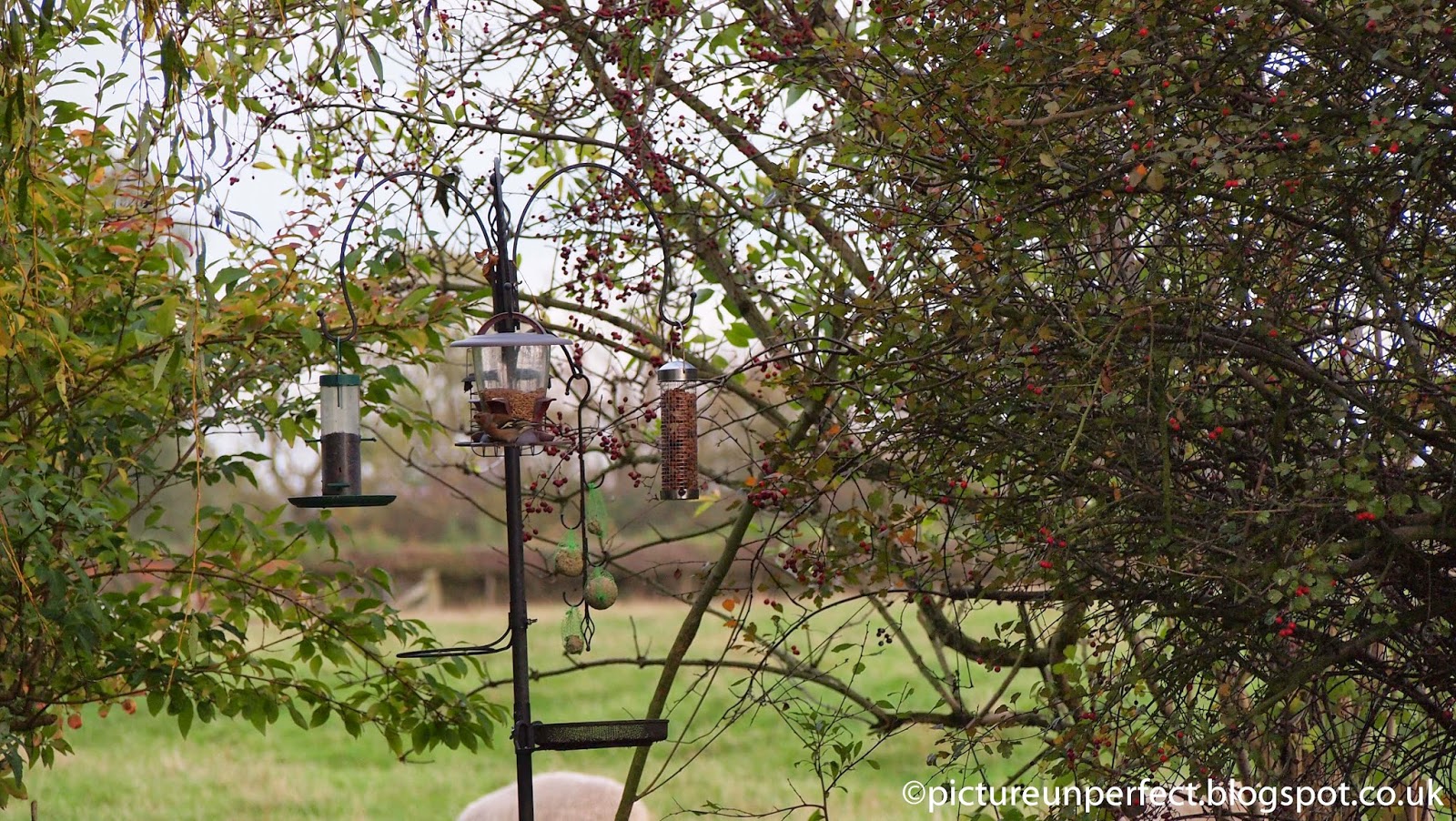
There are times when I think we have the most spoilt garden birds in the county.  Currently, we have nine different bird feeders in two locations around the garden in addition to two bird baths and a drinking spot.  The first feeding area is directly outside the kitchen window where the feeders hang from the branches of a silver birch tree. The second is a free standing feeder station that we located in the corner of the garden.

The feeding station in the corner of the garden.


There's been a fair bit of trial and error over the years but what we found works best for us in our particular garden can be completely different a few gardens away (our neighbour Bill regularly gets different bird visitors than ourselves despite being just over a hundred metres from us).  Here are a few tips that we've learnt over the years that might be helpful.

Reduce the Waste
We use peanuts, fat-balls, niger seed and by far the most popular are sunflower hearts.  Sunflower hearts are a little more expensive that sunflower seed but it does cut down on the messy seed husks the birds discard.  We were shocked to see a large brown rat one morning chomping away on the discarded husks, not what you want to see close to a kitchen door. Sunflower hearts definitely reduce the mess.

Niger seed, is very popular with goldfinches, but it will also kill the grass underneath the feeder after a while.  We use a niger feeder with an detachable tray, this cuts down on the amount of seed that hits the ground.

Location, Location, Location
Birds seem to prefer a bit of cover close to the feeders, so they can dash to safety should a Sparrowhawk or other predator put in an appearance.  We originally placed the feeding station in an open area of the garden and nothing used it.

A Bullfinch pays a visit


Feeders
The choice of available bird feeders now is staggering.  We've worked our way through quite a few and personally (for our circumstances anyway) more expensive metal feeders for the sunflower hearts and peanuts work best.  Remember that you need to clean and sterilise the feeders regularly to avoid any nasty diseases that can spread through the bird population and metal feeders tend to be more resilient to repeated disassembly and reassembly.

If you can provide a source of water for the birds as well, this would be fantastic.  You'll be surprised just how many birds this can attract to your garden.

A place to bathe is always welcomed


Squirrels
I'm not the greatest fan or grey squirrels and if you have them in your garden chances are they will pretty much trough what food you have out,  They can also destroy your feeders themselves by biting through the perch plugs and pulling them out, thus emptying the food all over the ground.  Metal feeders can stop the destruction but they can still get the food. (although they don't bother with niger seed so we just have a plastic feeder for this).  If you mix in chilli powder with the feed the squirrels won't go near it and it won't have any effect on the birds.  (I'm not totally heartless, I don't do this with the peanuts so they can eat something untainted).

The plastic birdfeeder was ruined within the week.


You can't stop
If you start putting food out for birds, especially in the winter months when food is scarce, then you need to understand that it is a long term commitment.  Birds will come to depend on this source of sustenance, and if you forget to refill the feeders or just plain stop then you could unwittingly have a detrimental impact on the bird population.

It is worth it, because you get to see things like this.

A Greater Spotted Woodpecker loves fat-balls.


Sunday, 26 October 2014

Animals


For this entry I thought I would post some more animal photographs.  I won't bore everyone with unnecessary wording this week.  There are a couple which do make me smile.

I hope you enjoy.


Boxer dog on guard


Patience is a virtue
 
Watching the lawn mowing


Chico, our neighbours' cat on the woodpile.

Patch, our neighbours' rescue dog and one of the nicest dogs you could meet.

Sunday, 19 October 2014

Housebound

 
I'm currently off work at the moment due to problems with my back which has greatly reduced my mobility (hopefully the consultant will be able to shine some light on the matter tomorrow). I can't walk very far or stand for very long and the medication leaves me dull of thought and dopey (although friends will say "no real change there, then").

All the photographs in this post where taken in the last ten days.  I've tried my hand at "Arty" pictures and last night we had a fantastic sunset that I managed to photograph from the back door.  In fact, most of these pictures were taken from the back door.  I hope you enjoy.

The Wisteria on the front of the cottage.

Silver Birch being buffeted by the autumn winds

The kitchen window

Full moon through a gap in he trees

Squirrel scoping out the bird feeders

Sunrise through the bedroom window

The sunset yesterday (Saturday 18th October)


Sunday, 12 October 2014

Camera Shy


In the very first post on this blog, I mentioned the Tawny owls that regularly roosted in the large conifers that mark the boundary of the garden.  They are a pair, one of them is more skittish than the other and will fly off if you hang around to long.   It's mate, tends to pretend you aren't there while keeping a half open eye on you but does tolerate me trying to take photos of it.   We were fortunate a couple of years ago to take some pictures of branching chicks in the trees (you can find that post here) but the adults themselves are elusive.

Tawny owls in the area appear to be thriving.  You can hear them calling when darkness falls and their calls come from all directions, warnings for others to keep out of their territory,  Our neighbour has told me that he can hear eight or nine of them when returning from the village pub.  We see them land in the tree outside the bedroom window but they are gone before you can get a camera trained on them.  They have a couple of trees in the garden that they favour to sleep in during the day.  At this moment in time, they have also added our neighbour's willow tree as one of their roosting spots.

They've chosen well as they pick the most photograph unfriendly location.  High up, in the gloom and blocked by thin branches (the camera tends to focus on these so the owls almost always manage to be out of focus).


The picture below is one of the better shots I've taken as it the owl decided to sun itself in a different tree that was relatively unobscured.

Hopefully, one day I'll get the opportunity to get a perfect shot of one or both of them.

This post is dedicated to my older brother.  Every time he pays a visit, the owls aren't around and he was beginning to think they were fictitious.


Saturday, 4 October 2014

The High Life


Last week there was some building work going on at the house to rebuild the chimney.  With the scaffolding erected it was the perfect opportunity to see the village from a different prospective.

As I am currently crocked again with back problems, Terry took to the scaffolding to take the photographs.  You can see that autumn is well and truly with us here in the UK.


Sunday, 28 September 2014

Watch The Skies


I love a great sunrise or sunset.  The pictures below were done mainly in the garden or hanging out of the bedroom window.


No effect has been added.  This was a particularly vivid solstice sunset in December 2013.